The Chovevei Zion (Lovers of Zion) Society in Rhodesia
predominantly centered in Bulawayo—represents one of the earliest, most fervent, and structurally significant chapters of organized Zionism in Southern Africa. Despite the extreme geographic isolation of the region in the late 19th and early 20th centuries, this small community demonstrated an extraordinary commitment to the Zionist movement.
1. Foundation and Impressive Early Enrollment (1898)
The Bulawayo branch of the Chovevei Zion Society was officially established in 1898, a mere four years after the first Jewish congregation was formed in the town in 1894.
What makes the Bulawayo chapter particularly remarkable is its near-universal local support:
By 1900, there were roughly 300 Jewish residents in Bulawayo (which constituted about 76% of the entire Jewish population of Rhodesia at the time).
Out of approximately 220 adult members in the community, 170 were registered, active members of Hovevei Zion.
This incredibly high density of affiliation (nearly 80% of the adult Jewish population) made the local community uniquely pro-Zionist compared to many contemporary Jewish communities in Europe or North America.
2. Dual Identity: Pioneers and Refugees
The makeup of the early Chovevei Zion society in Rhodesia was shaped by two distinct waves of migration:
The Litvak Influence: Many of the early members were Litvaks (Lithuanian Jews) who arrived via South Africa. They brought with them a deep, traditional love of Hebrew culture and the early Hibbat Zion ideals that had originated in Eastern Europe.
The Frontier Spirit: They were simultaneously economic pioneers, political refugees fleeing Tsarist oppression, and rugged frontiersmen. They managed to balance the intense physical demands of building a life on the African frontier—initially praying in temporary structures like tents—with a sophisticated, globally connected political ideology.
3. Incorporation into the South African Zionist Federation (SAZF)
Shortly after the local society was established, its reach expanded beyond a purely localized group:
In 1898, the South African Zionist Federation (SAZF) was formed as the first national communal Jewish organization in Southern Africa.
Theodor Herzl himself had written to early Zionist leaders in South Africa, urging them to organize. The Bulawayo Chovevei Zion branch was quickly incorporated as one of the furthest-reaching northern outposts of the SAZF, establishing a direct pipeline of communication and fundraising from the heart of Rhodesia to the global Zionist Congresses.
4. The Influence of Rev. Moses Isaac Cohen (1900 onwards)
The society’s momentum and spiritual depth were heavily accelerated by the arrival of Rev. Moses Isaac Cohen in 1900.
Arriving from London to serve as the minister of the Bulawayo Hebrew Congregation, Cohen was a passionate, highly articulate Zionist.
Under his leadership, Zionist education and cultural programming became the absolute bedrock of Jewish communal life in Rhodesia. Cohen ensured that the early impulses of the Chovevei Zion society matured into a highly organized, lifelong educational movement that paved the way for subsequent generations of youth movements (such as Betar and Habonim) and women’s organizations (like WIZO).
5. A Legacy of Grassroots Mobilization
The late 19th-century foundations of Chovevei Zion set a precedent for what would become a hallmark of the Zimbabwean Jewish community throughout the 20th century:
Per Capita Contributions: The grassroots fundraising culture established by these early “Lovers of Zion” helped Southern African Jewry become some of the highest per-capita contributors to pre-state Israel (via the Jewish National Fund blue boxes and direct collections) in the entire world.
Evolution of the Press: The literary and cultural focus of the early society eventually gave rise to vibrant local publications, such as The Jewish Guild Journal (established in Bulawayo in 1919), which heavily documented and promoted Zionist projects, Hebrew literature, and community debates.
From Emma Gampell
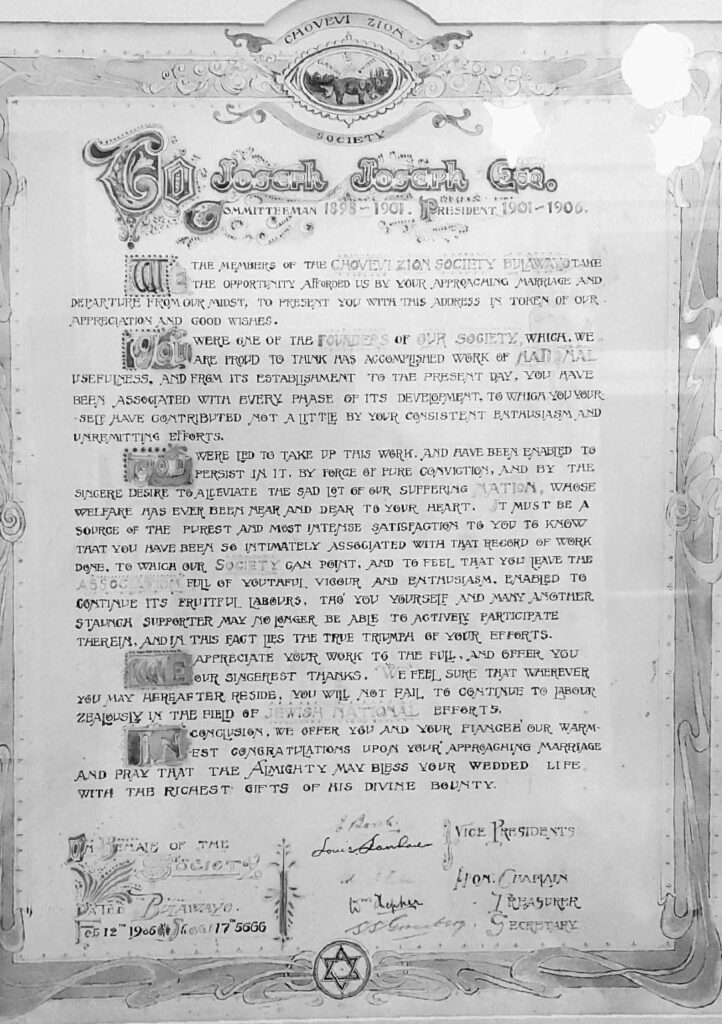
July 5th 2026 – Following on from the earlier post about the early history of Chovevi Zion in Bulawayo, this is a Black and White copy of the certificate awarded (see below with AI extracted text) to my Great-grandfather Joseph Joseph who was President from 1901 -1906 on his engagement to my Great-grandmother Fanny Rabinovitz. They moved back to the UK Following their marriage but the rest of her family remained in Bulawayo. The original colour certificate still hangs in pride of place in my sister’s home in London.
Chovevi Zion Society
To Joseph Joseph, Esq.
Committeeman 1898–1901. President 1901–1906.
The members of the Chovevi Zion Society, Bulawayo, take the opportunity afforded us by your approaching marriage and departure from our midst, to present you with this address in token of our appreciation and good wishes.
You were one of the founders of our Society, which, we are proud to think, has accomplished work of national usefulness, and from its establishment to the present day, you have been associated with every phase of its development, to which you yourself have contributed not a little by your consistent enthusiasm and unremitting efforts.
You were led to take up this work, and have been enabled to persist in it, by force of pure conviction, and by the sincere desire to alleviate the sad lot of our suffering nation, whose welfare has ever been near and dear to your heart. It must be a source of the purest and most intense satisfaction to you to know that you have been so intimately associated with that record of work done, to which our Society can point, and to feel that you leave the Society full of youthful vigour and enthusiasm, enabled to continue its fruitful labours, tho’ you yourself and many another staunch supporter may no longer be able to actively participate therein, and in this fact lies the true triumph of your efforts.
We appreciate your work to the full, and offer you our sincerest thanks. We feel sure that wherever you may hereafter reside, you will not fail to continue to labour zealously in the field of Jewish National efforts.
In conclusion, we offer you and your fiancée our warmest congratulations upon your approaching marriage and pray that the Almighty may bless your wedded life with the richest gifts of His Divine bounty.
On behalf of the Society
Dated: Bulawayo, 5 December 1906 / 17 Kislev 5666
The signatures and some officers’ names at the bottom are difficult to read clearly, but the printed positions include:
Vice Presidents
Hon. Chaplain
Treasurer
Secretary
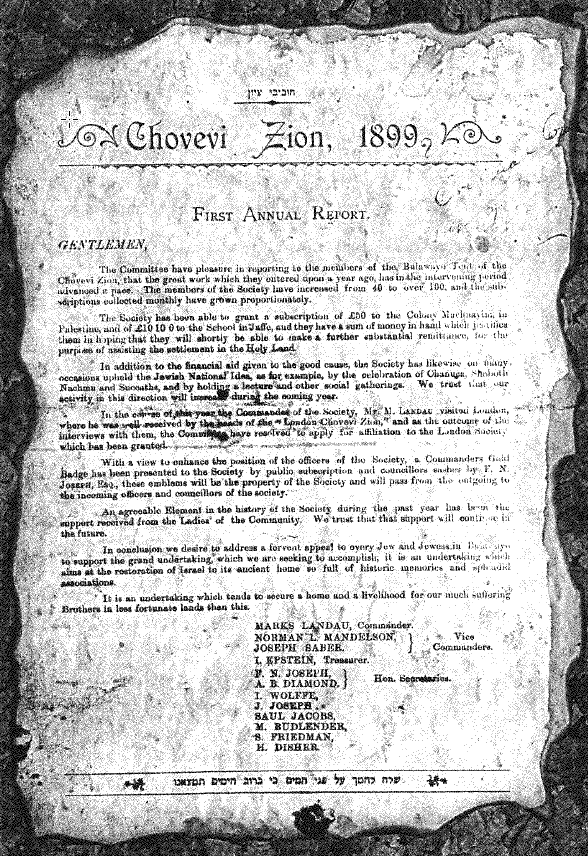
Below is a copy of the original First Annual Report of Chovevei Zion in Bulawayo in 1899. Below this image is a clean textual representation of the content.
(with grateful thanks to Jill Sher for sending this copy)
חובבי ציון
CHOVEVI ZION, 1899
FIRST ANNUAL REPORT
Bulawayo Tent of the Chovevi Zion
Clean transcription from the surviving scanned copy
Editorial note: The original is damaged and faint in places. The wording below has been modernly typeset while preserving the original spelling, capitalization and punctuation as closely as possible. A few uncertain readings are shown in square brackets.
GENTLEMEN,
The Committee have pleasure in reporting to the members of the Bulawayo Tent of the Chovevi Zion, that the great work which they entered upon a year ago, has in the intervening period advanced apace. The members of the Society have increased from 40 to over 100, and the subscriptions collected monthly have grown proportionately.
The Society has been able to grant a subscription of £50 to the Colony ‘Machanaim’ in Palestine, and of £10 10 0 to the School in Jaffa, and they have a sum of money in hand which justifies them in hoping that they will shortly be able to make a further substantial remittance, for the purpose of assisting the settlement in the Holy Land.
In addition to the financial aid given to the good cause, the Society has likewise on many occasions upheld the Jewish National Idea, as for example, by the celebration of Chanuca, Sabbath Nachamu and Succoth, and by holding a lecture and other social gatherings. We trust that our activity in this direction will increase during the coming year.
In the course of this year the Commander of the Society, Mr. M. Landau, visited London, where he was well received by the heads of the ‘London Chovevi Zion,’ and as the outcome of his interviews with them, the Committee have resolved to apply for affiliation to the London Society, which has been granted.
With a view to enhance the position of the officers of the Society, a Commander’s Gold Badge has been presented to the Society by public subscription and councillors’ sashes by F. N. Joseph, Esq.; these emblems will be the property of the Society and will pass from the outgoing to the incoming officers and councillors of the society.
An agreeable element in the history of the Society during the past year has been the support received from the Ladies of the Community. We trust that this support will continue in the future.
In conclusion we desire to address a fervent appeal to every Jew and Jewess in this town to support the grand undertaking which we are seeking to accomplish; it is an undertaking which aims at the restoration of Israel to its ancient home so full of historic memories and splendid associations.
It is an undertaking which tends to secure a home and a livelihood for our much suffering Brothers in less fortunate lands than this.
OFFICERS AND COUNCILLORS
MARKS LANDAU | Commander |
NORMAN L. MANDELSON | Vice Commander |
JOSEPH SABEL | Vice Commander |
L. EPSTEIN | Treasurer |
W. N. JOSEPH | Hon. Secretary |
A. B. DIAMOND | Hon. Secretary |
I. WOLFFE | |
J. JOSEPH | |
SAUL JACOBS | |
M. BUDLENDER | |
S. FRIEDMAN | |
H. DISHER |
[Hebrew motto at foot of original: partly illegible in the scan]