BRIEFING FOR THE PRESIDENTS OF ISRAEL AND ZAMBIA
by Aviva Elkaim Ron
Early contribution of Jewish immigrants to commerce and development before Independence of Zambia
The first Jewish immigrants came through then Bechuanaland and Barotseland at the end of the 19th Century, after a wave of progoms in the Russian empire. Most came from Lithuania; almost all were desperate refugees with no capital. Many were butchers, cattle traders, millers and inn-keepers. Through negotiations with the chiefs in the Western Province of Zambia, cattle and beef trading became major enterprises and the foundation of trading empires and farms established by Susman, Wulfsohn and Galaun families. Their influence in the development of Livingstone town was significant, and later spread to Lusaka when it became the new capital. Jack Fischer was the first Jewish Member of Lusaka’s Town Council and served as Mayor from 1960-62. His nephew, Stanley Fischer, was born in Mazabuka, where his parents had a merchant store. Stanley Fischer was Governor of the Bank of Israel from 2005 – 2013.
At its peak, the number of Jews in Zambia grew to 1,200. The number was increased between 1939 and 1942 when around 100 families from Nazi Germany were given visas after negotiations between the British Government and the Legislative Council of Northern Rhodesia (as recorded in the book Haven in Africa). These families settled mainly in Livingstone and the mining towns on the Copperbelt. The Hebrew Congregations, as they were termed, built synagogues first in Livingstone, then Lusaka, Ndola, Mufulira, Luanshya and Kitwe.
The contribution of Jewish activists to the Independence of Zambia
Simon Ber Zukas and his family came from pre-war Lithuania to Northern Rhodesia because it did not employ quotas limiting Jewish settlers — unlike South Africa and Southern Rhodesia. They settled in Luanshya, and Simon later studied civil engineering at the University of Cape Town. He turned to radical student politics and joined the main nationalist movement, the African National Congress, when he returned to Northern Rhodesia.
An active participant in the country’s struggle for independence, he was eventually deported to Britain but, following statehood, was invited in 1965 to return by the new country’s president, Kenneth Kaunda. Simon Zukas served as the first Minister of Agriculture for 16 years. Later, his attempts to persuade the late President Kenneth Kaunda and his United National Independence Party to abandon a one-party state failed and, in 1990, he joined the drive towards multi-party politics. Zukas held several positions in the MMD government. He was later a leader in the Forum for Democracy and Development, an opposition political party. He retired from politics in 2005. After retirement from politics, he was active in the Council for Zambian Jewry, an umbrella organisation of the Jewish Congregations of Zambia.
Simon Zukas, one of Zambia’s independence heroes and most admired figures, died aged 96 in September 2021. President Hakainde Hichilema accorded an official funeral to the late Simon Zukas and declared a day of national mourning in recognition of the numerous contributions he made towards the attainment of freedom in the country.
Simon’s wife – Cynthia Zukas was a Zambian painter; she received the Order of the British Empire in 2012.Cynthia Zukas was born in 1931 in Cape Town, where she started her art career, and later went to London where she studied as an art teacher. There she met Simon Zukas who she later married. Cynthia Zukas set up the Lechwe Trust to promote and support Zambian artists.
Recognition of the contribution of Jewish activists
Hanania Elkaim came to Northern Rhodesia in 1938, from Palestine. He worked his 4-year contract with a road constructor who had paid for him to get off the boat in Beira, and later bought the company. He explained the concept of Zionism to his workers and provided transport to get people to rallies in the build-up to Independence. On the 26th Anniversary of Zambian Independence in 1990, Hanania Elkaim was awarded the Order of Distinguished Service (First Division) from President Kaunda and called him a Freedom Fighter. His daughter, Aviva Elkaim Ron, immigrated to Israel in 1960, studied at the Hebrew University and received a doctorate in Public Health from the Johns Hopkins University in the USA, which gave her the Global Achievement Award in 2014 in recognition of her career in the World Health Organization. Aviva Ron is a founding member of the National Council for Children in Israel. The Elkaim family still supports the Barefoot Chisankano Community School near Ndola.
On the 50th Anniversary of Zambian Independence, gold medals were awarded to 5 Jews for their contribution to the development of Zambia; all had remained in Zambia after Independence in 1964: Michael Galaun, Hanania Elkaim (posthumously), Dennis and Maureen Figov, Simon Zukas
The establishment of the Copperbelt University School of Medicine in 2014
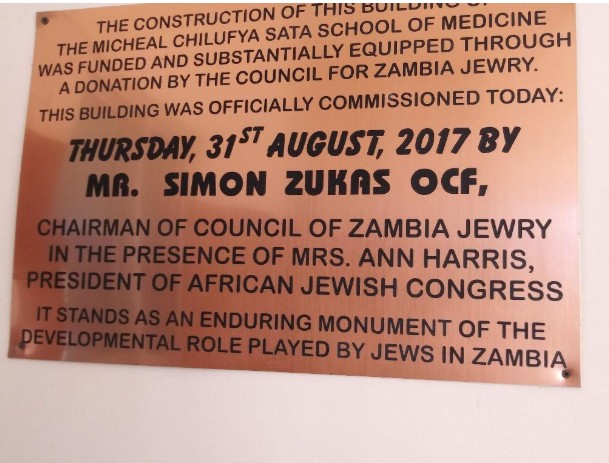
The last synagogue, in Lusaka, was sold in 2014. The Council of Zambian Jewry, then chaired by the late Michael Galaun, decided to donate funds accumulated from the sale of all the synagogues in Zambia to establish a medical school at the Copperbelt University and to renovate the School of Public Health in the Tel Aviv University Medical School. The sum of US$ 1,000,000 was allocated to each. The first donation enabled the first building and a lecture theatre at the medical school and completion of the campus was funded by government funds. In 2017 the late Simon Zukas inaugurated the building, now named the Hebrew Congregation Building and the lecture hall is the Simon and Cynthia Zukas Theatre. All the classrooms bear the names of leaders of the Copperbelt Jewish Congregations and the Jewish doctors in Ndola and Lusaka. The donation to establish the School of Medicine was seen as “payback” for the opportunities given to the Jews of Zambia, most of whom were penniless refugees.
The second donation, to the School of Public Health at Tel Aviv University, included an amount for collaboration between the two schools. This has enabled Zambians to come to courses and Israelis to teach in the Master of Public Health programme at the School of Medicine, located in Ndola from 2018 till the present.
References
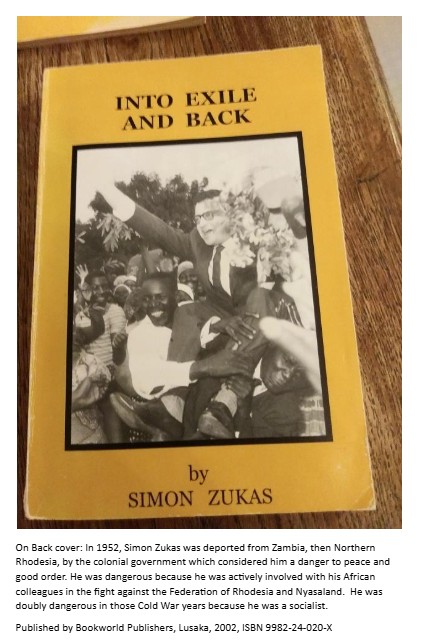
On Back cover: In 1952, Simon Zukas was deported from Zambia, then Northern Rhodesia, by the colonial government which considered him a danger to peace and good order. He was dangerous because he was actively involved with his African colleagues in the fight against the Federation of Rhodesia and Nyasaland. He was doubly dangerous in those Cold War years because he was a socialist.
Published by Bookworld Publishers, Lusaka, 2002, ISBN 9982-24-020-X
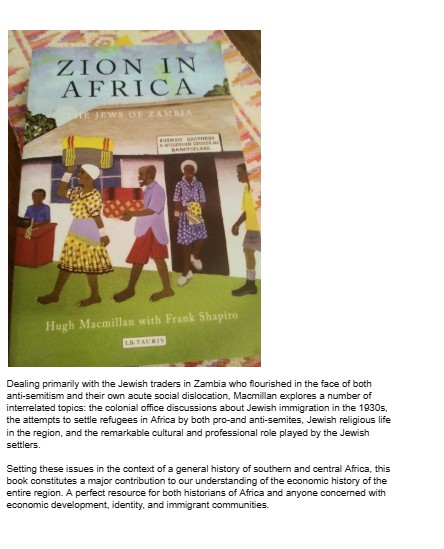
Dealing primarily with the Jewish traders in Zambia who flourished in the face of both anti-semitism and their own acute social dislocation, Macmillan explores a number of interrelated topics: the colonial office discussions about Jewish immigration in the 1930s, the attempts to settle refugees in Africa by both pro-and anti-semites, Jewish religious life in the region, and the remarkable cultural and professional role played by the Jewish settlers.
Setting these issues in the context of a general history of southern and central Africa, this book constitutes a major contribution to our understanding of the economic history of the entire region. A perfect resource for both historians of Africa and anyone concerned with economic development, identity, and immigrant communities.
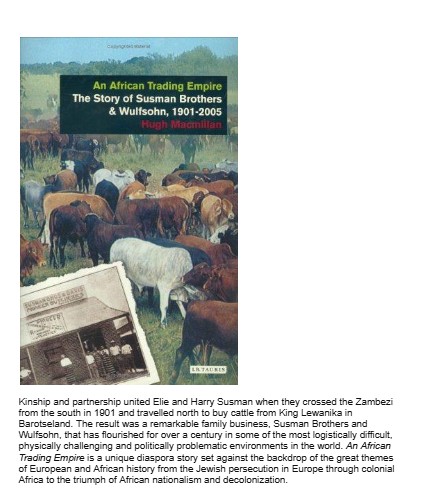
Kinship and partnership united Elie and Harry Susman when they crossed the Zambezi from the south in 1901 and travelled north to buy cattle from King Lewanika in Barotseland. The result was a remarkable family business, Susman Brothers and Wulfsohn, that has flourished for over a century in some of the most logistically difficult, physically challenging and politically problematic environments in the world. An African Trading Empire is a unique diaspora story set against the backdrop of the great themes of European and African history from the Jewish persecution in Europe through colonial Africa to the triumph of African nationalism and decolonization.
New evidence that has come to light regarding the destiny of Jews in Nazi Europe. An extraordinary opportunity of salvation almost crystallized into actuality. Central European Jewry was on the brink of being rescued. The facts must be stated up front: masses of Jews were about to be evacuated from Europe and allowed to settle in Northern Rhodesia, a British protectorate situated in southern central Africa.